

Al Isaacs
Joined May 2026

Al Isaacs is a writer, storyteller, and retired comedian whose work blends humor with deeply personal truth. Twice named Long Island’s Best Comedian by the Long Island Press, he spent more than twenty years teaching improvisational comedy at theaters, comedy clubs, corporate events, and Hofstra University’s Continuing Education program. His memoir, Finding Mary Smith, tells the true story of accidentally discovering his gray market adoption and the extraordinary, against-all-odds journey to find his birth family after more than fifty years. Known for finding humor in unlikely places, Isaacs writes with honesty, heart, and a comedian’s instinct for timing—even when the subject turns deeply emotional. He lives in the New York area with his wife and son, and believes that the best stories are the ones that prove real life is stranger, funnier, and more meaningful than fiction.
Books by Al Isaacs
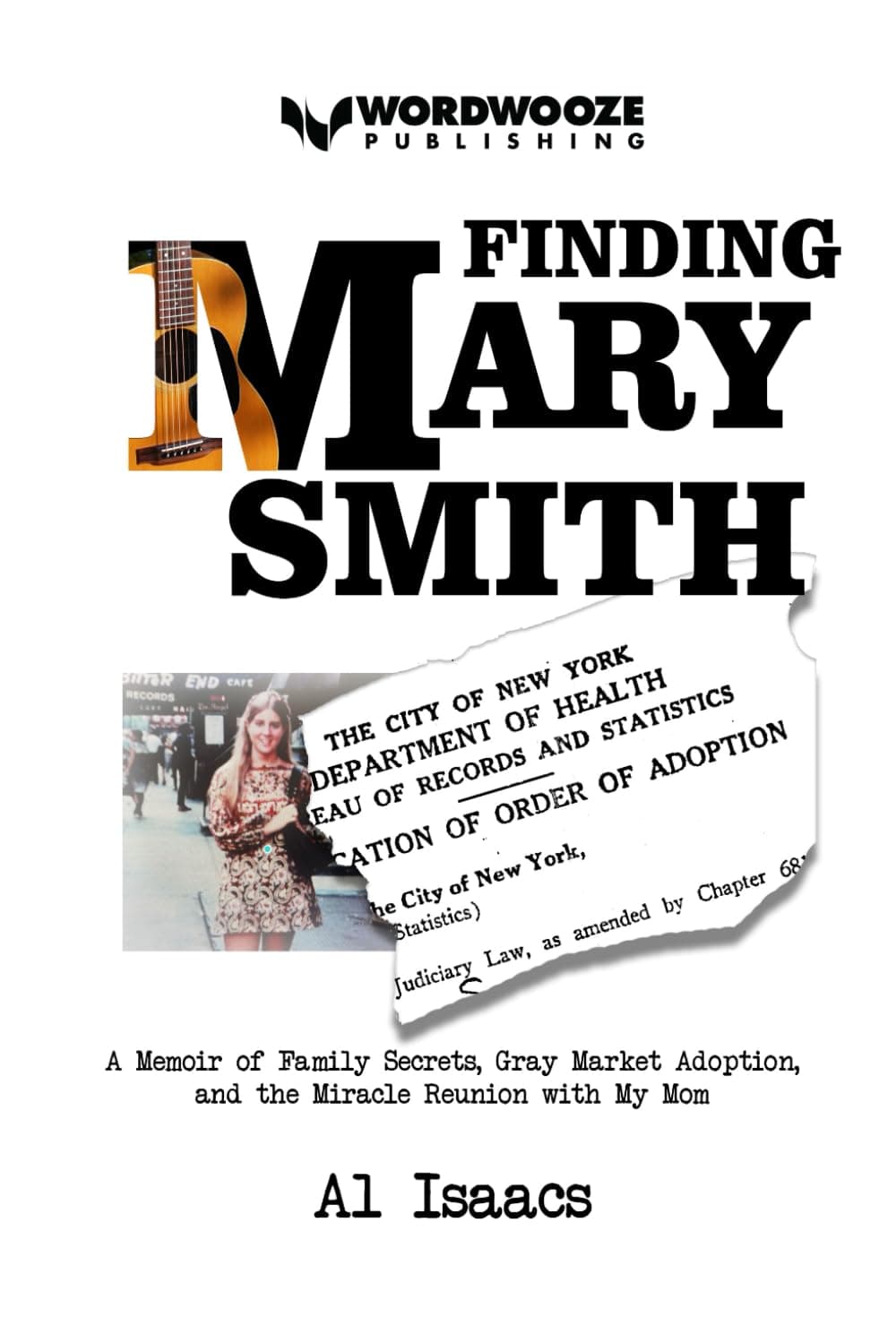
Writing Finding Mary Smith was both one of the most challenging and meaningful experiences of my life. What began as a personal search to understand my own beginnings slowly turned into a story about identity, family, and the unexpected ways our lives can change. When I discovered at age fifty that I had been adopted, I had no idea it would lead me down a path of DNA tests, long-lost relatives, surprising connections, and emotional discoveries.
As a former comedian, I've always believed humor helps us navigate life's twists and turns, and that perspective followed me throughout this journey. While parts of this story are deeply personal, I hope readers will also find moments of warmth, humanity, and even a few smiles along the way.
My hope in sharing this story is that it resonates with anyone who has ever searched for where they belong—whether through adoption, family history, or simply trying to understand their place in the world. If Finding Mary Smith helps even one person feel less alone in their own search for answers, then telling this story will have been worth it.
Thank you for reading and for being part of the journey.
— Al Isaacs
Links
Fan Mail
Sid's Dream
Short StoryAdded May 18, 2026
In October 1967, articles and ads began appearing across the country announcing that New
York based songwriter/musician/orchestra leader Sidney (His name was alternately shortened
in articles to “Syd” or “Sid.” According to his son Eric, he preferred “Sid.”) Bass was planning
on having what the newspapers excitedly referred to as a “Rock ’n’ Roll Miss America
Pageant” to be held the following year. They were looking for “youthful musical talent” with
“go-go looks.”
You know, “Go-go looks.”
Okay, I don’t know what that is, either, but I think we can surmise that it meant
“attractive.”
Just one example from the Pennsylvania Standard-Speaker on December 27, 1967
I almost missed the big announcement completely in the October 8th Evansville Press on
Page 87, as the story came right after the news that Ken Berry might replace Andy Griffith as
the lead on television’s The Andy Griffith Show, and I was stuck wondering why that wouldn’t
make it The Ken Berry Show if Andy was out. My brain does that, and believe me, I am none
the better for it.
As The Glens Falls Times put it in February 1968, Sound of Youth was “the first national
program to coordinate the interests of government, labor and industry with those of the
entertainment world through such a constructive recreational activity of American Youth.” If
that doesn’t scream “rock and roll,” I don’t know what does.
Some papers went so far as to put a potential cure for the common “juvenile delinquent”
spin on the competition. The January 7, 1968 edition of The Daily Breeze in Torrance,
California was hoping that this contest would “substitute the enthusiasm of a rock ’n’ roll vocal
group for the desire to throw rocks at school windows.” Yes, the newspaper folks probably
should have flipped that sentence, but you get the gist of their views on the young people of
the day.
Sid Bass was a 45-year-old songwriter and orchestra leader from New York who had some
showbiz success. Don’t confuse him with the Texas billionaire investor also named Sid Bass.
Our Sid was first accompanying acts like Desi Arnez and Della Reese in the mid-50s, then
arranging credits a few years later for Frankie Valli and the Four Seasons’ hits “Sherry” and
“Big Girls Don’t Cry.” He received a Grammy award nomination for his arrangement of Gale
Garnett’s “We’ll Sing in the Sunshine” in 1964, losing out to Barbara Streisand’s “People.”
Baseball fans in New York hear his music every time “Here Come the Yankees” is played
before each New York Yankee radio broadcast. Now he was looking for financial backers to
run this nationwide talent search he was calling Sound of Youth. Mr. Bass was about to bring
his competition to the airwaves 37 years before Simon Cowell ever donned a black T-shirt on
American Idol.
First were the local shows held in over 100 cities. In Michigan alone thirteen contests were
held, each with a sponsorship from a chapter of the Jaycees, also known as the United States
Junior Chamber. The organization helped young adults develop leadership skills through
community service, individual training, management skills, and business development.
Graduates included Presidents, Senators, Hall of Fame athletes, and even Elvis. Before girls
were allowed to join in 1984, the Jaycees had more than 300,000 members. Judges for the
preliminary rounds of Sound of Youth included Sid Bass, the head of the local Jaycees chapter,
a representative from Kapp Records, and usually the mayor of the town where the contestants
competed. They divided the categories into group for bands of five or fewer, male vocalist, and
female vocalist. Participants competed at local and state levels before a final televised round,
where one winner was crowned. Very Idol-esque.
Sid had big hopes for Sound of Youth. He changed the name to Sound of Youth, U.S.A.,
with visions of taking the competition international. He is quoted as saying, “Music knows no
boundaries, and young people all over the world are creating and singing their own music. It is
an international language and can create good-will amongst young people all over the world.”
A big step in that direction was partnering with Alexander Cantwell (remember that name for
later), producer of The Miss America Pageant to handle the televised finals, giving a new level
of credibility and experience to the team.
Originally scheduled to be held in Miami Beach, the finals with the top contestants in each
category was taped live on August 5 - 6, 1968 in a New York television studio, hosted by the
legendary Duke Ellington. Judges that night included singer Tommy James (without The
Shondells), saxophonist King Curtis, Gary Loizzo, the lead singer from American Breed, as
well as Father Norman O’Connor, “The Jazz Priest.” The Sound of Youth, U.S.A. finals aired
nationwide on November 16, 1968.
Alas, young Sid’s lofty plan for global conquest was not to be. Bass couldn’t get sponsors
for a year two series, so 1968 marked the one and only airing and the end of Sound of Youth.
Why do I bring all of this to your attention?
Sid Bass passed away in June 1993 at the age of 80. And while his obituary in Brattleboro,
Vermont’s newspaper talked about his work at RCA, his many orchestrations, and how Sid
arranged the songs of Staff Sergeant Barry Sadler, including his 1966 patriotic hit “The Ballad
of the Green Berets,” the obituary did not mention the Sound of Youth contest.
Nor did it mention how the grand prize winner of the only national Sound of Youth
competition ever held was a very talented 18-year-old girl from Flint, Michigan named Mary
Ellen Smith.


